
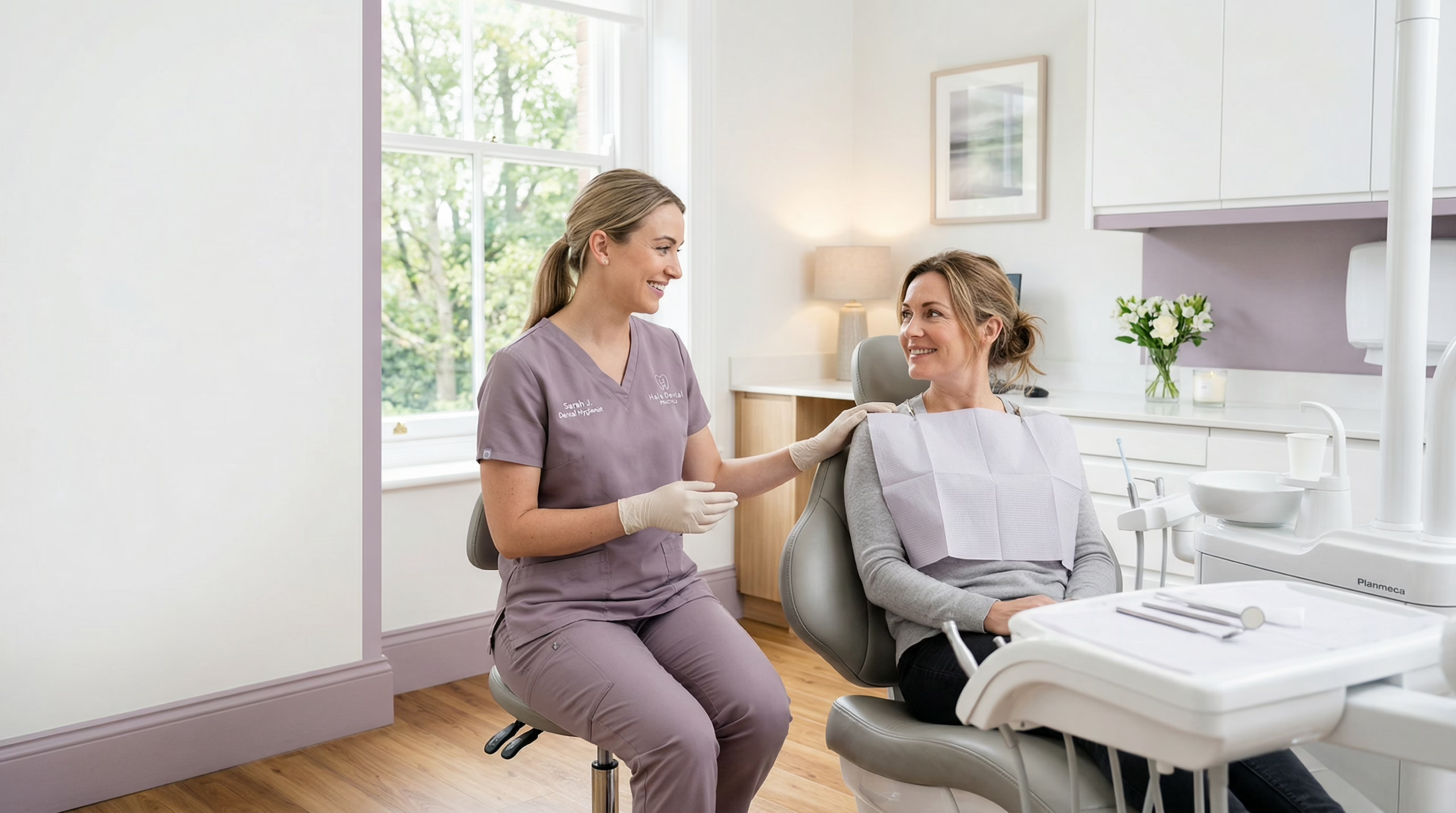
Dental Hygienist in Liverpool and Formby
If you are looking for a dental hygienist Liverpool patients can reach easily from Formby, Crosby or Southport, Azure Dental offers gentle hygiene care, Airflow cleaning and practical gum health support in a calm, pain-free setting.
What a dental hygienist Liverpool patients visit us for
A hygienist does much more than simply polish teeth. Instead, our hygiene visits are designed to support gum health, reduce plaque and tartar build-up, freshen breath and make it easier for you to keep your mouth healthy between appointments. In addition, a hygienist can help maintain implants, Invisalign attachments and other dental work that depend on good plaque control.
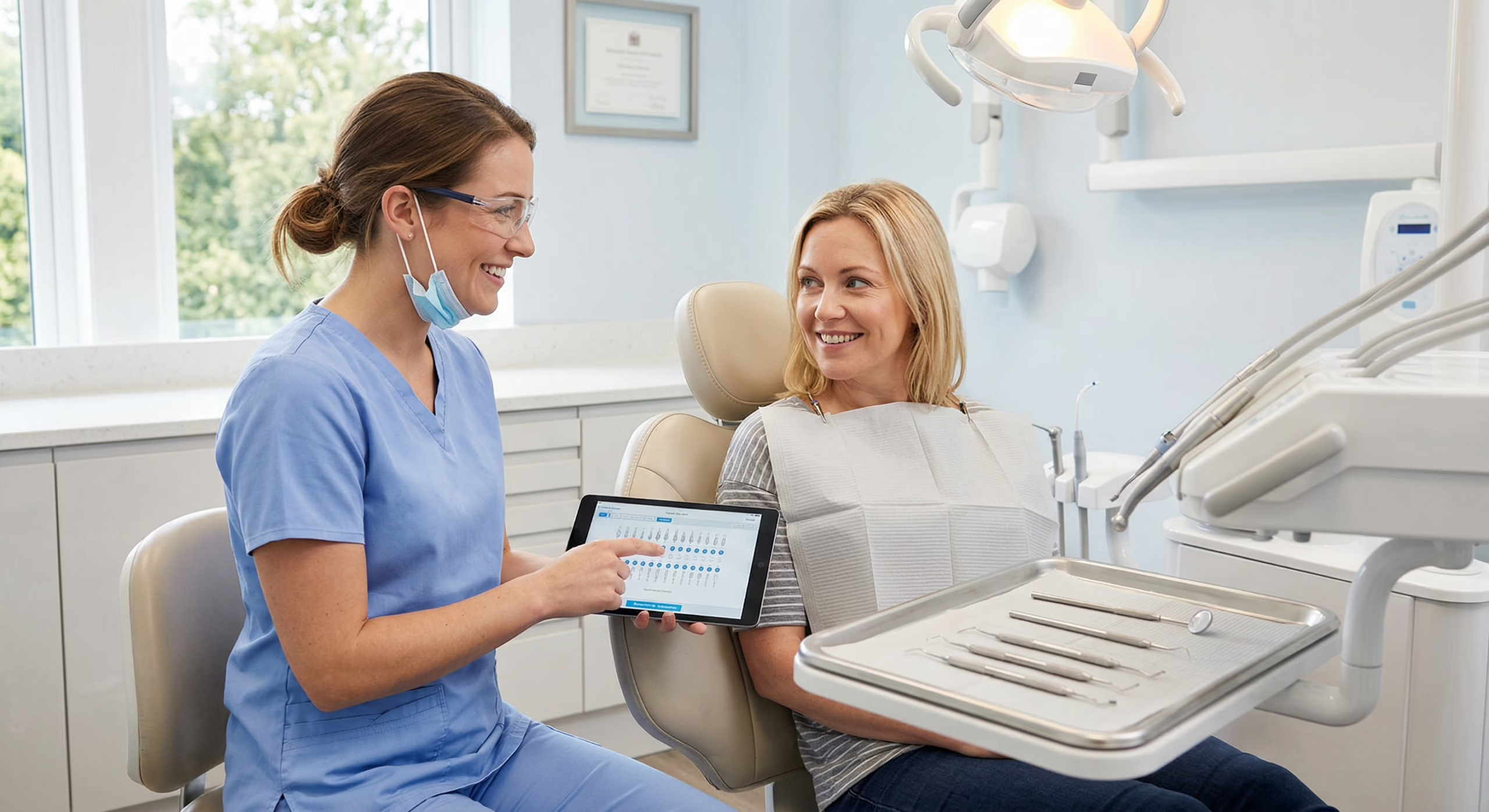
Professional teeth cleaning and plaque removal
- Plaque and tartar removal
- Stain reduction
- Fresh breath support
- Tailored home-care advice
Support for healthier gums
- Bleeding gums support
- Gum disease maintenance
- Airflow guided biofilm therapy
- Reviews based on your risk level
When should you book a hygiene appointment in Liverpool or Formby?
It is worth booking if your gums bleed when you brush, your breath never feels fresh, you can see tartar near the gumline or you simply want to stay on top of prevention. Many patients also book hygiene visits before whitening, during Invisalign treatment or as part of implant maintenance. However, if you already have active gum inflammation, start with our gum disease treatment page as well.
Dental hygienist Liverpool patients choose for gum health support
Patients searching for a dental hygienist Liverpool page often want more than a simple clean. They want prevention, consistency and clear advice. Therefore, if you have had bleeding gums, periodontal treatment or recurring inflammation in the past, a hygienist appointment is often part of the long-term plan. You can also learn more about what does a dental hygienist do and what happens at a dental hygiene appointment.
Airflow cleaning for a gentler hygiene visit
Many patients love Airflow because it is a more modern way to disrupt biofilm and lift surface staining. As a result, it can be especially useful for patients who want a fresher-feeling clean with a gentler approach. Visit our Airflow dental cleaning page to see whether it may suit you.
In addition, regular hygiene visits can make it easier to maintain gum health over time. For example, patients with implants, Invisalign or recurring bleeding often benefit from a tailored maintenance plan.
Why patients choose Azure Dental for hygiene care
- Calm, pain-free approach
- Modern hygiene technology
- Consistent gum health support
- Formby location for patients across Liverpool and the surrounding area
Many patients book a hygiene appointment for professional teeth cleaning, fresher breath and ongoing gum health support. Therefore, many patients choose ongoing hygiene care rather than waiting for bleeding, staining or discomfort to return.
Book your hygiene visit today
If you need a dental hygienist Liverpool patients can reach easily from Formby and nearby areas, we can help you keep your smile cleaner, fresher and more stable over time. Moreover, whether you want routine prevention, stain removal or support with bleeding gums, we will keep the approach calm and practical.
Dental hygienist Liverpool FAQs
What does a dental hygienist do?
A dental hygienist removes plaque, tartar and surface staining, supports gum health, helps manage bad breath and gives tailored advice on brushing, flossing and interdental cleaning.
How often should I see a hygienist?
That depends on your gum health, plaque build-up and risk level. Some patients do well with six-monthly visits, while others benefit from three-monthly maintenance.
Can I see a hygienist without seeing a dentist first?
In many cases, yes. However, the right pathway can depend on your needs and the type of care required, so contact the practice if you are unsure.
Is a hygienist appointment painful?
Most appointments are very manageable. We focus on a calm, gentle approach, and Airflow can also make some hygiene visits feel more comfortable.
Do hygienists help with gum disease?
Yes. Hygienists play a key role in supporting gum disease treatment and maintenance by reducing plaque, cleaning around the gumline and helping patients improve daily cleaning.
What is the difference between a hygienist and a dentist?
A dentist diagnoses, plans and provides a wider range of treatments, while a hygienist focuses on preventive care, professional cleaning and gum health support.
Is Airflow included in every hygiene appointment?
Not always. It depends on what is clinically appropriate and what type of clean you need.
Can a hygienist help with bad breath?
Yes. Plaque, tartar and gum inflammation can contribute to bad breath, so hygiene treatment often helps improve it.
Related pages
Explore more about professional teeth cleaning, gum health support and Airflow cleaning if you are comparing the right hygiene appointment for your needs.
Listen: Dental Hygienist & Preventive Care
From our podcast Partners in Your Dental Health.
Read the full transcript
Host 2: I'm looking at a um surprisingly thick stack of materials today.
Host 1: Oh yeah, it is a lot of information.
Host 2: It really is. We have clinical care protocols, patient education guides, and uh detailed practice literature all sourced directly from Azure Dental. Right. They're a clinic based in the UK, and they've put together some really comprehensive notes on how they approach preventive care, specifically the role of the dental hygienist.
Host 1: Which is such a misunderstood role, honestly.
Host 2: Completely. And you know, for those of you tuning in from Formby, Liverpool, Southport, or Crosby, this is right on your doorstep.
Host 1: Brilliant for local listeners, yeah.
Host 2: But even if you are thousands of miles away, the mission of today's deep dive is entirely universal. We are going to completely demystify what actually happens in a dental hygiene visit. Trevor Burrus, Jr.
Host 1: Because there's a lot of mystery there for most people.
Host 2: Exactly. We're going to look at the biology, the technology, and the psychology of why so many of us absolutely dread the chair and why we really shouldn't.
Host 1: The psychology of it is a really fascinating place to start, actually. Because um we tend to view dental care through a completely different lens than we view other forms of routine maintenance.
Host 2: I was just thinking about this. It's like think about how we treat our cars.
Host 1: Right.
Host 2: Once a year, like clockwork, you book an MOT. You do not wait for the engine to seize up on the motorway or, you know, the exhaust pipe to drag on the tarmac.
Host 1: No, of course not. You'd be stranded.
Host 2: Exactly. Yeah. You take it in, a mechanic checks the fluids, replaces the filters, and you drive away feeling secure. You pay for that maintenance because you understand that ignoring it leads to a, well, a catastrophic, incredibly expensive breakdown later. Spot on. But then we look at our own bodies, specifically our mouths, and that proactive logic just totally evaporates.
Host 1: It really does. The human tendency is to be entirely reactive with oral health. I mean, we wait for the proverbial dashboard warning light to start flashing.
Host 2: Like a toothache.
Host 1: Exactly. A sharp pain when drinking cold water, a swollen gum, or a throbbing toothache in the middle of the night. And only then do we rush to find a clinic, often in a total state of panic.
Host 2: Yeah. Which is the worst time to go.
Host 1: It is. Yeah. So the materials we are examining today from Azure Dental, they represent a fundamental shift away from that crisis-driven model. But uh before we delve into the clinical specifics outlined in these documents, I do need to establish a very clear parameter for our discussion today.
Host 2: Right. The ground rules.
Host 1: Exactly. The insights we are unpacking from these sources provide general educational information. They do not constitute personal dental advice.
Host 2: Right, because my mouth is different from your mouth, which is different from the listener's mouth.
Host 1: Precisely. Biology is inherently variable. Every single mouth presents a unique ecosystem with its own genetic predispositions, structural challenges, and bacterial flora.
Host 2: So what works for me might not work for someone else.
Host 1: Completely. What serves as the correct clinical pathway for one individual might be completely inappropriate for another. So we will be using measured realistic language today. Words like can, may, or design to. Right. No absolute guarantees. Exactly. We are not promising miracles or permanent cures because that simply isn't how healthcare operates. If the concepts we discussed today resonate with you, the responsible next step is always to book a consultation with a qualified professional for guidance tailored to your specific anatomical and clinical situation.
Host 2: No magic wands, just biology, chemistry, and as we'll find out later, some really cool physics.
Host 1: Oh, the physics part is brilliant.
Host 2: I can't wait to get to that. So I want to start with a fundamental misunderstanding. If I ask the average person on the street what a hygienist does, they usually say, oh, they do the scale and polish, they make your teeth look nice before a wedding.
Host 1: Yeah, that is the classic stereotype.
Host 2: We treat it like a cosmetic top-up. But looking through these clinical notes, the scope of their work is entirely different. So why do we even need a hygienist if we already have a dentist? Shouldn't the dentist just clean my teeth while I'm there?
Host 1: It's a fair question, but to understand the distinct roles, we really need to look at how dentistry has evolved into highly specialised fields.
Host 2: Okay.
Host 1: A dentist is primarily a diagnostician and a structural engineer.
Host 2: Yeah.
Host 1: Their clinical focus is on identifying pathology like decay or an infection and performing structural repairs.
Host 2: So they're the ones doing the heavy lifting, structurally speaking.
Host 1: Right. They're the ones placing fillings, performing root canal therapy, extracting compromised teeth, or engineering complex restorations like crowns and bridges.
Host 2: Wow. Okay.
Host 1: Their expertise is centered on the hard tissues and the architectural integrity of the mouth.
Host 2: I see. So if we stick with the house analogy, the dentist is the architect who designs the extension and the structural engineer who comes in to fix a hole in the roof or, you know, replace a broken window.
Host 1: That's a great way to look at it, yes.
Host 2: Where does the hygienist fit into that blueprint then?
Host 1: Well, the hygienist is the specialist dedicated to the foundation.
Host 2: The foundation.
Host 1: Exactly. You could commission the world's most brilliant architect to build a stunning house utilising the most expensive materials available. But if that house is built on soil that is actively eroding, oh, the whole thing is coming down. The entire structure is going to collapse, regardless of how beautifully the windows were installed. In the mouth, the gums and the underlying jawbone are that foundation. Right. The hygienist focuses almost exclusively on preventive care, managing the biological environment, and safeguarding that soft tissue and bone. Because if you lose the foundation, you lose the tooth. Even if the tooth itself is completely free of decay.
Host 2: Okay, that makes so much sense. The dentist fixes the house, the hygienist stops the ground from swallowing it.
Host 1: Precisely.
Host 2: So when we look at the specific tasks Azure Dental lists for a hygiene visit, the very first one is always removing plaque and tartar.
Host 1: The big ones, yeah.
Host 2: We hear these words thrown around in every toothpaste commercial, usually accompanied by an animation of a shiny shield protecting a tooth. Let's break down the actual microbiology here. Because I always thought plaque was just leftover food from lunch, like tiny bits of sand which stuck to my enamel.
Host 1: You and most of the population. That is a very common misconception.
Host 2: So it's not just food.
Host 1: No. Plaque is not merely food debris. It is a highly organised, living biological structure known as a biofilm.
Host 2: Well, living structure.
Host 1: Yes. The human mouth is an incredibly hospitable environment for microbes. I mean, think about it. It is warm, it maintains a constant high humidity, and it receives a regular influx of nutrients.
Host 2: Sounds like a perfect holiday resort for bacteria.
Host 1: It really is. Within hours of brushing your teeth, a thin coating of salivary proteins called the pellicle forms over the enamel.
Host 2: The pelicle, okay.
Host 1: And this pellicle acts like double-sided sticky tape. Pioneer bacteria, which are naturally present in your mouth anyway, attach to this tape and begin to multiply.
Host 2: So it's more like a microscopic coral reef growing on the tooth.
Host 1: That is a very accurate way to visualize it, actually. And as these bacteria multiply, they excrete a sticky, glue-like substance called an extracellular matrix.
Host 2: A matrix, like a slime.
Host 1: Yes, exactly like a slime. This matrix acts as a protective dome, shielding the bacterial colony from environmental threats and even making them highly resistant to antimicrobial mouthwashes.
Host 2: Wow. So they build their own little bunker.
Host 1: They do. And inside this dome, the bacteria communicate with each other, they share nutrients, and they thrive. They feed primarily on the fermentable carbohydrates you consume. And as a byproduct of metabolizing those sugars, they excrete acid.
Host 2: Right, and that biofilm feels fuzzy, doesn't it? Like when you wake up, before you brush your teeth, you run your tongue over your molars and they feel like they're wearing tiny rough jumpers.
Host 1: Yes.
Host 2: That's the bacterial colony I'm feeling.
Host 1: You are feeling the physical architecture of that biofilm. Now at the soft stage, the biofilm is vulnerable to mechanical disruption.
Host 2: Meaning I can brush it off.
Host 1: Exactly. The bristles of a toothbrush and the friction of dental floss can break apart that matrix and sweep the bacteria away. The biological complication arises because human brushing habits are, well, rarely perfect.
Host 2: I am definitely guilty of rushing it sometimes.
Host 1: We all are. Yeah. We consistently miss the same areas, usually the lingual surfaces behind the lower front teeth, the very back molars, and the critical junction where the tooth meets the gum line.
Host 2: Okay, let's talk about what happens when we miss those spots. The notes here say plap turns into tartar, or calculus. How does a soft, fuzzy layer of bacteria turn into something hard? Does it like fossilize?
Host 1: It's similar, yeah. The mechanism is a fascinating chemical process called mineralization.
Host 2: Mineralization.
Host 1: Yes. Your saliva is packed with dissolved minerals, primarily calcium and phosphate.
Host 2: Work are good things, right.
Host 1: Normally, yes. These minerals are crucial for neutralizing acids and constantly repairing microscopic damage to your enamel. However, when plaque is left undisturbed for roughly 24 to 72 hours, the calcium and phosphate ions in your saliva begin to precipitate out of the fluid.
Host 2: Okay, and where do they go?
Host 1: They deposit themselves directly into the bacterial biofilm.
Host 2: Wait, so the saliva actually accidentally builds a fortress for the bacteria?
Host 1: In a sense, yes, it really does. The minerals crystallize the sticky matrix. The soft plaque hardens into a substance called dental calculus or tartar.
Host 2: And that's the hard stuff.
Host 1: Exactly. Once this mineralization occurs, the rules of engagement completely change. Calculus is incredibly dense. It has the consistency of concrete or limestone.
Host 2: Oh wow. So brushing won't do anything.
Host 1: You cannot remove it with a manual toothbrush. You cannot floss it away.
Host 2: I assume this is where people try to brush aggressively and end up doing more harm than good. Because I know I've been guilty of scrubbing harder when I feel a rough spot, hoping it'll just buff out.
Host 1: Oh, please don't do that. Brushing harder against calculus is entirely futile and actively destructive.
Host 2: Destructive how?
Host 1: The bristles will simply bend against the stone like tartar, but they will severely abrade the delicate gum tissue right next to it, causing recession and damage. Furthermore, calculus presents a highly porous, rough surface under a microscope. It acts like a jagged coral reef, providing the perfect secure scaffolding for a brand new layer of living plaque biofilm to attach to.
Host 2: So it just builds on itself.
Host 1: It accelerates the accumulation process exponentially.
Host 2: It's a vicious cycle then. The tartar creates a safe harbor for the new bacteria, shielding them from the toothbrush right against the vulnerable gum line.
Host 1: Which is precisely why professional intervention is required. A hygienist undergoes extensive training to utilise specialised hand instruments and ultrasonic devices that can fracture and dismantle that hardened calculus.
Host 2: Without breaking the tooth.
Host 1: Exactly. Without scratching the underlying enamel. Removing this mineralized deposit resets the biological environment. You simply cannot establish a healthy baseline until that porous scaffolding is completely cleared away.
Host 2: And clearing that away leads us to a benefit that I think drives a lot of people to the clinic stain reduction.
Host 1: Oh, yes. A very popular benefit.
Host 2: The Azure Dental Materials mention that a hygiene visit tackles surface staining. We drink tea, coffee, red wine, we eat curries. Does the stain just sit on top of the tooth, or is it getting trapped in that tartar we just talked about?
Host 1: It is a combination of both, actually. The deeply pigmented molecules in these foods and drinks are called chromogens. Chromogens, okay. And chromogens have a strong chemical affinity for the proteins in that salivary pellicle we discussed earlier. Over time, these pigments embed themselves into the microscopic pores of the enamel itself.
Host 2: That makes sense. But what about the tartar?
Host 1: Well, the calculus we just described is highly absorbent. It acts like a sponge pulling in the stains from tobacco smoke or coffee, often turning brown or even black near the gum line.
Host 2: Turning black. Wow. So when the hygienist removes the tartar, they are inherently removing a massive amount of the discolouration with it. Correct. It's not just a vanity thing. The stain is literally trapped inside the bacterial fortress.
Host 1: Exactly. The professional removal of the biofilm and the calculus inherently lives a significant burden of pigmentation. Hygienists also employ specialised polishing techniques to smooth the enamel surface, which makes it much harder for new stains to adhere in the future.
Host 2: So it stays cleaner for longer.
Host 1: Right. Patients often notice a drastically brighter, cleaner appearance straight away.
Host 2: And there's a psychological domino effect there, I imagine. When you run your tongue over your teeth and they feel like polished glass, you don't want to ruin it. You become much more mindful of your brushing habits because you want to preserve that feeling.
Host 1: The motivational aspect of a hygiene visit cannot be overstated. Experiencing a clean, healthy mouth provides a tactile baseline. When a patient knows what healthy feels like, they are much quicker to notice when plaque begins to accumulate again, which prompts them to improve their daily routine.
Host 2: That ties directly into another major focus mentioned in the source materials supporting fresh breath.
Host 1: A very sensitive topic for many.
Host 2: It is. Bad breath, or helitosis, carries a huge social stigma. People buy endless amounts of mints and mouthwashes trying to fix it. I've read that bad breath can come from your stomach, but is that really the main culprit?
Host 1: Well, systemic issues like gastrointestinal reflux or sinus infections can occasionally contribute to halatosis, sure. Correct. But clinical data indicates that the vast majority of chronic bad breath originates locally right inside the oral cavity.
Host 2: Right in the mouth.
Host 1: Yes. And the mechanism goes right back to the microbiology of the biofilm.
Host 2: It's the bacteria again. What exactly are they doing that causes the smell?
Host 1: We need to look at a specific subset of the microbiome for this anaerobic bacteria.
Host 2: Anaerobic meaning they don't like oxygen.
Host 1: Exactly. These are bacteria that thrive in environments devoid of oxygen, such as the deep crevices in the back of the tongue or the spaces below the gum line. These bacteria metabolize proteins. Okay. When you consume protein-rich foods or even just from the natural shedding of dead cells within your mouth, these anaerobic bacteria break those proteins down into their component amino acids.
Host 2: Okay, so they're eating protein. Where does the actual smell come from?
Host 1: The chemical byproduct of that metabolic process. As they break down amino acids, particularly those containing sulfur, they release volatile sulfur compounds or VSCs.
Host 2: Volatile sulfur compounds? That sounds pungent.
Host 1: It is. The two most common are hydrogen sulfide and methylmercaptin.
Host 2: Okay, what do those smell like?
Host 1: To put that into perspective, hydrogen sulfide is the exact chemical compound responsible for the odor of rotten eggs.
Host 2: Oh, gross.
Host 1: And methylmercaptin is the compound that gives feces its characteristic smell.
Host 2: Wow. Okay, that is incredibly vivid and slightly horrifying.
Host 1: It's just the biological reality of what's happening on a microscopic scale.
Host 2: So when we use a commercial alcohol-based mouthwash, we aren't actually solving the problem, are we? We're just pouring a strong mint scent over the top of hydrogen sulfide.
Host 1: Precisely. Masking the odor does not stop the chemical production. To genuinely address halatosis, you must reduce the bacterial load. Get rid of the bugs. Right? By professionally removing the calculus, which, remember, harbors these anaerobic bacteria deep against the gums where oxygen cannot reach them. The hygienist destroys their habitat. They physically remove the source of the volatile sulfur compounds.
Host 2: So we've established that the hygienist acts as a specialised foundation expert. They dismantle the tartar fortresses, they lift the trap stains, and they evict the sulfur-producing bacteria.
Host 1: That's a good summary, yeah.
Host 2: But this brings us to a crucial point in the Azure notes about tailored home care advice. Because let's be honest, if I sit in the chair for 45 minutes twice a year, that leaves over 8,700 hours a year where I am entirely responsible for my own mouth.
Host 1: And that is the most critical time. The clinical intervention is only half of the equation. Right. A hygiene appointment is not a passive service where you simply lie back and get fixed. It is an active coaching session.
Host 2: A coaching session. I like that.
Host 1: A skilled hygienist will evaluate the specific topography of your mouth. They will observe your brushing technique and identify the exact areas you are consistently missing.
Host 2: I always feel a bit like a child being scolded when someone asks about my flossing habits, to be honest.
Host 1: A lot of people feel that way.
Host 2: But it sounds like it's meant to be more like a personal trainer analysing your deadlift form.
Host 1: That is an excellent comparison, yes. If you are performing an exercise with poor form, you risk injury and fail to build muscle.
Host 2: Right.
Host 1: If you are brushing with incorrect angulation or using a brush with bristles that are too firm, you will cause gingival recession. You are physically scrubbing the gums away from the roots of the teeth.
Host 2: Which nobody wants.
Host 1: Exactly. So the hygienist will recommend specific, customised tools. They might determine that traditional string floss cannot reach the concave surfaces of your specific molars.
Host 2: Because everyone's teeth are shaped differently.
Host 1: Exactly. And they will physically demonstrate how to use specialised interdental brushes to effectively clear the biofilm from those unique anatomical spaces.
Host 2: Customisation is key then. So understanding the how and the what naturally leads to the next major question: who actually needs to book an appointment? Is this purely for people who are in pain, or is there a specific set of warning signs we should be looking out for?
Host 1: Well, while preventive care is universally beneficial, there are definitive physiological red flags that indicate the biological environment in the mouth is deteriorating.
Host 2: Okay, what's the biggest one?
Host 1: The most prevalent of these, which the Azure Dental Materials strongly highlight, is bleeding gums.
Host 2: Okay, let's linger on this because bleeding gums are so incredibly common that I think society has completely normalised them.
Host 1: Unfortunately, yes.
Host 2: People see a little pink in the sink when they spit out their toothpaste and they rationalize it immediately. Oh, I was rushing today, or I bought a new toothbrush and the bristles are a bit stiff.
Host 1: We hear those excuses all the time.
Host 2: Right. But if I wash my hands and they start bleeding, I go to the hospital, but when our gums bleed, we just ignore it. Why do they bleed? Is it just friction?
Host 1: Not at all. Healthy gum tissue is incredibly resilient. It is designed to withstand the immense forces of chewing rough, hard foods. It absolutely should not bleed from the mild friction of a toothbrush bristle.
Host 2: So what's actually happening?
Host 1: The bleeding is an active immune response.
Host 2: An immune response.
Host 1: Yes. When the bacterial biofilm, the plaque we discussed earlier, is permitted to accumulate and stagnate along the gum line, those bacteria continuously excrete acidic byproducts and biological toxins.
Host 2: And the body detects those toxins as a foreign invasion.
Host 1: Exactly. The human immune system is highly sophisticated. It recognises the toxin penetrating the soft tissue and mounts an inflammatory defense.
Host 2: Okay, what does that defense look like?
Host 1: The body initiates vasodilation. The blood vessels within the gum tissue expand dramatically to allow an influx of white blood cells, specifically neutrophils, to travel to the site and fight the bacterial infection.
Host 2: So the gums become literally engorged with extra blood to fight the battle.
Host 1: Yes. This localized inflammation is called gingivitis. Because the tissue is swollen with excess blood, the microscopic capillaries become stretched, fragile, and pushed very close to the surface of the gum. Oh, I see. At this stage, the slightest mechanical disruption, the sweep of a toothbrush, a piece of floss, or even just biting into an apple will cause those fragile, engorged capillaries to rupture.
Host 2: Wow. So the bleeding isn't caused by brushing too hard. It's caused by the fact that the tissue is so infected and swollen that it can't handle normal brushing anymore.
Host 1: Exactly. You are witnessing an active, open wound. It is your body waving a red flag, signaling that an infection is present.
Host 2: The tragedy is that human instinct dictates the exact wrong response here. When people see blood, they get scared, they assume the toothbrush is hurting them, so they stop brushing that specific area to, you know, let it heal.
Host 1: Which is the worst thing you can do.
Host 2: Right. Because by avoiding the area, they leave the bacterial biofilm completely undisturbed.
Host 1: Which ensures the toxins continue to flow into the tissue, prompting an even more aggressive immune response, leading to more swelling and more bleeding.
Host 2: It just spirals.
Host 1: It becomes a rapid, self-perpetuating cycle of deterioration. A hygiene visit interrupts this cycle. By professionally removing the calcified irritants and the bacterial load, the hygienist eliminates the source of the immune system's panic.
Host 2: They remove the splinter, basically.
Host 1: Yes, exactly. Once the toxins are gone, the blood vessels constrict, the sweating subsides, and the tissue can physically heal, becoming firm, pink, and resilient once again.
Host 2: Okay, so bleeding is a massive indicator. Bad breath and visible tartar buildup are others, but the agile materials branch into a really interesting area that moves beyond just natural teeth.
Host 1: Oh, yes. Implants and orthodontics.
Host 2: Right. They place a huge emphasis on safeguarding dental work, specifically dental implants. Now, I have to admit, my internal logic always told me that an implant is the ultimate permanent solution.
Host 1: A lot of patients feel that way.
Host 2: Right. It's a titanium screw driven into the jaw, topped with a porcelain crown. It is inorganic, it can't get a cavity. Therefore, once it's in, you don't need to worry about it. I'm guessing that logic is flawed.
Host 1: It is a fundamentally dangerous assumption, and unfortunately, it is a very common one. Patients invest significant time and financial resources into implant therapy, assuming it is maintenance free.
Host 2: Because it's metal and porcelain.
Host 1: It is true that the titanium post cannot decay and the porcelain crown will never get a cavity. However, the implant does not exist in a vacuum. It is surrounded by living, vulnerable human tissue, the gums and the jawbone.
Host 2: And those tissues can still get infected, but is an implant. Really more vulnerable than a normal tooth?
Host 1: It actually is. To understand the vulnerability, we have to look at the microanatomy of a natural tooth versus an implant.
Host 2: Okay, lay it on me.
Host 1: A natural tooth is not rigidly fused to the jawbone. It is suspended in the socket by a complex network of soft ticfibres called the periodontal ligament.
Host 2: Like a shock absorber system for chewing.
Host 1: Precisely. It absorbs mechanical stress, but more importantly, the periodontal ligament has an incredibly rich blood supply and its own robust network of immune cells. It acts as a highly effective barrier against bacterial invasion.
Host 2: Okay, so natural teeth have this built-in defense system.
Host 1: A dental implant, however, lacks this ligament entirely. Through a process called osteointegration, the jawbone grows directly into the microscopic threads of the titanium post. The connection is completely rigid.
Host 2: So if there is no ligament, what stops the bacteria from sliding right down the side of the implant into the bone?
Host 1: The only defense is a soft tissue seal where the gum hugs the base of the implant crown. This seal is biologically weaker and more fragile than the complex detachment around a natural tooth.
Host 2: So it's a weak point.
Host 1: Yes. If the sticky bacterial biofilm is allowed to accumulate at the base of an implant, the resulting inflammation, which we previously identified as gingivitis, can progress much more rapidly.
Host 2: Because there's no ligament to fight it off.
Host 1: Right. Because the immune barrier is weaker, the bacteria can quickly penetrate the connective tissue and begin destroying the surrounding jawbone.
Host 2: What happens when the bone around the titanium screw starts to dissolve?
Host 1: This specific condition is called periimplantitis. As the bone erodes, the implant loses its structural support. It can become loose, painful, and ultimately it can fail entirely and need to be surgically removed.
Host 2: Wow, that's a huge deal.
Host 1: It is. This is why routine hygiene visits for implant patients are absolutely critical. The hygienist uses specialised non-metallic instruments, often made of specific plastics or carbon fibre, designed specifically to effectively remove the biofilm and calculus.
Host 2: Wait, why can't they just use the normal metal tools?
Host 1: Because metal tools would scratch the delicate titanium surface of the implant, which would otherwise create new microscopic ledges for bacteria to hide in.
Host 2: Oh, that makes total sense. It really reframes the idea of maintenance. You aren't just cleaning a tooth, you are actively protecting a massive investment from a very specific type of biological failure. And speaking of investments, let's explore another modern dental trend. The notes highlight clear aligner therapy, like Invisalign.
Host 1: Very popular right now.
Host 2: Very. We think of orthodontics as straightening teeth, but what does that have to do with the hygienist? Isn't it cleaner to use removable plastic trays rather than old school metal brackets and wires?
Host 1: Well, removable align do offer significant hygiene advantages over fixed metal braces, as you can obviously take them out to brush and floss.
Host 2: Right.
Host 1: However, the mechanics of moving teeth with alignuse unique challenges. Teeth are smooth, and clear plastic align often struggle to grip a round tooth tightly enough to rotate it or pull it downward.
Host 2: So how do they grip it?
Host 1: To solve this, dentists bond small tooth-coloured composite resin bumps directly onto the enamel. These are called attachments.
Host 2: Ah, I've seen those. They act like little handles for the plastic tray to grab onto, but I'm guessing if the tray can grab onto them, the biofilm can too.
Host 1: Exactly. These attachments create dozens of microscopic ledges, sharp angles, and undercuts across the surface of your teeth. They dramatically increase the surface area and provide perfect sheltered scaffolding where food debris and plaque can become firmly wedged.
Host 2: And then you snap a tight plastic tray over the top of it?
Host 1: This is where the biological environment changes radically. You are instructed to wear these align for 22 hours a day.
Host 2: Right.
Host 1: When the aligner is seated, you are effectively sealing your teeth inside a warm, moist, plastic incubator. Normally, your saliva constantly washes over your teeth, buffering acids and flushing away bacteria. The plastic aligner blocks the saliva from reaching the enamel.
Host 2: So if you eat lunch, do a quick lazy brush, and put your align back in, you've just locked a bacterial colony against your enamel and taken away the saliva that usually protects you.
Host 1: You have created a highly acidic sheltered greenhouse. The trapped bacteria rapidly metabolize the trapped carbohydrates, and the concentrated acid remains flush against the tooth surface for hours.
Host 2: That sounds disastrous.
Host 1: It accelerates the demineralisation of the enamel, creating permanent white spot lesions or active cavities, and triggers intense genuine inflammation around the attachments.
Host 2: That sounds like a nightmare. You spend all this time and money to get perfectly straight teeth, and you finish the treatment only to find they are covered in white stains and surrounded by bleeding gums.
Host 1: Which is why integrating professional hygiene visits into an orthodontic treatment plan is not a luxury, it is a clinical necessity. The hygienist ensures that those complex attachments are thoroughly cleaned, monitors the health of the gums under the stress of tooth movement, and adjusts the patient's home care routine to manage the unique challenges of the aligners.
Host 2: So we know why we need to go and who really needs it, but I want to touch on a practical logistical question from the Azure Dental Materials. They mentioned something called direct access.
Host 1: Yes, this is a great system.
Host 2: Historically, going to the hygienist felt like getting a secondary prescription. You had to book an exam with the dentist, pay for that, sit through the diagnosis, and then the dentist would essentially write a permission slip for you to go see the hygienist down the hall. Is that still how it works?
Host 1: Not always, no. The regulatory landscape in the UK shifted significantly to remove unnecessary barriers to preventative care. In many scenarios, you can now utilise direct access to book an appointment directly with the dental hygienist or dental therapist without needing a prior examination or referral from a dentist.
Host 2: That seems incredibly efficient for someone who just knows they want a professional clean or stain removal before an event.
Host 1: It is highly efficient and empowers patients to take control of their maintenance routine. However, there is a critical clinical caveat that we must emphasise here.
Host 2: Okay, what's the cache?
Host 1: Direct access is brilliant for maintenance, but it is not a diagnostic shortcut. Hygienist is diagnosing and treating gum disease. They're not diagnosing complex structural issues like deep decay, failing root canals, or oral cancer. If a patient is experiencing acute, throbbing pain, a broken tooth, or significant swelling, booking a direct hygiene visit is the wrong clinical pathway.
Host 2: Because they can't fix a broken tooth, so you've just wasted your own time and money.
Host 1: Correct. For complex issues, a comprehensive examination by a dentist is absolutely the required first step. The front of house team at a clinic like Azure Dental is trained to triage these increase. If you call them and describe your symptoms, they will guide you as to whether direct access hygiene is appropriate, or if a dentist needs to evaluate you first.
Host 2: Okay, we've covered the logistics and the biology. Now we have to address the elephant in the room.
Host 1: Let me guess. Nerves.
Host 2: The anxiety, the fear. For a massive percentage of the population, just hearing the word hygienist triggers a visceral physiological stress response. Their heart rate goes up, their palms sweat. It's very common, sadly. They remember visits from 20 years ago that were, quite frankly, traumatic. They remember the high-pitched whine of the tools, the sharp metal scraping against the root of the tooth, the freezing cold water triggering immense sensitivity. It felt like an ordeal. How has modern dentistry changed to make this manageable? Because if people are terrified, they won't go, no matter how much we talk about biofilms and bone loss.
Host 1: Acknowledging and validating dental anxiety is the absolute cornerstone of modern clinical care. That fear is a very real neurological response, usually rooted in past trauma, sensory overload, or just the profound psychological vulnerability of lying backward while someone utilises sharp instruments in a highly sensitive area of your body.
Host 2: It's the ultimate loss of control.
Host 1: Exactly. The modern approach, which is heavily emphasised in the Azure Dental philosophy, is designed to systematically dismantle that anxiety. It begins before the patient even reaches the chair. It is about creating a calm environment, establishing clear communication, and returning control to the patient.
Host 2: Returning control. Yes.
Host 1: They dictate the pace. If they need a break, the procedure stops.
Host 2: Manageable is the operative word here. We aren't pretending it's a hot stone massage at a luxury spa. It is a clinical medical procedure. But it absolutely does not have to be a torturous experience. No, no. And a massive part of neutralizing that fear involves upgrading the actual physical tools being used. The notes mention a technology called airflow-guided biofilm therapy.
Host 1: Airflow is fantastic.
Host 2: The name sounds incredibly futuristic. What is airflow?
Host 1: Airflow represents a true paradigm shift in the mechanical removal of biofilm and stains. Traditionally, as you described, the primary tools were hand scalers, sharp metal curettes used to physically scrape the tooth surface or ultrasonic instruments. Right. Ultrasonics use a metal tip that vibrates at exceptionally high frequencies, up to 30,000 times a second, to shatter the calculus.
Host 2: And it's that vibration and the high-pitch squeal it makes that sets people's teeth on edge. Plus, they usually blast freezing cold water to cool the vibrating tip down, which is agony if you have sensitive teeth.
Host 1: The sensory input of traditional ultrasonics can be intense. Airflow operates on a fundamentally different physical principle. Instead of mechanical scraping or high frequency vibration, it utilises kinetic energy.
Host 2: Let's delve into the physics of that. How do you clean a tooth with kinetic energy without touching it with a metal instrument?
Host 1: The airflow device projects a highly controlled, pressurized stream of three elements: air, water, and a microfined powder. This mixture is directed onto the surface of the tooth.
Host 2: It sounds a bit like power washing a dirty tatio, but scaled down to a microscopic level.
Host 1: That is a very accurate analogy. The kinetic energy of the water and powder mixture gently but highly effectively disrupts the sticky biofilm matrix, blasting the bacteria and surface stains away from the enamel.
Host 2: What exactly is in this microfine powder? Is it basically just microscopic sand? Because blasting sand at my enamel sounds like it would ruin it.
Host 1: It is emphatically not sand. The materials used are biologically engineered for dental application. While sodium bicarbonate used to be common, modern systems frequently utilise a specialised sugar alcohol called erythritol.
Host 2: Wait, a sugar alcohol? Like an artificial sweetener?
Host 1: Yes, exactly like that.
Host 2: Why on earth would we blast a sugar derivative onto our teeth when we just established that sugar feeds the bacteria and causes cavities? That seems completely counterintuitive.
Host 1: I know it sounds mad, but the mechanism there is actually quite brilliant. Erythritol is sweet, but its molecular structure is entirely different from sucrose, the sugar we consume in our diets.
Host 2: Okay, so the bacteria don't recognise it.
Host 1: Exactly. The kerogenic bacteria in the biofilm, the ones that cause decay, lack the specific enzymes required to metabolize erythritol. They try to consume it, but they cannot break it down to produce acid.
Host 2: So it's like feeding them tiny microscopic plastic apples. They chew on it but get zero nutrition.
Host 1: Exactly. It effectively starves them while simultaneously disrupting their structural matrix. Furthermore, the erythritol powder particles are incredibly fine, often around 14 microns in diameter. Which means they are so small, they do not abrade or scratch the enamel, they simply bounce off the hard surface, transferring their kinetic energy to the soft plaque and stains.
Host 2: And it can reach places a metal scraper can't.
Host 1: Because it is a fluid dynamic, the powder and water spray can penetrate deep into the microscopic pits, fissures, and grooves of the teeth. And crucially, it can clean slightly below the gum line far more comfortably than a rigid metal instrument trying to navigate a curved root surface.
Host 2: And what about the cold water problem?
Host 1: Modern airflow units allow the clinician to regulate the temperature of the water. Using warm water completely neutralizes the sharp jarring pain of dent and hypersensitivity that so many patients dread.
Host 2: That is huge.
Host 1: It really is. The combination of no scraping, no high frequency vibration, and warm water results in a remarkably comfortable, fresher feeling experience.
Host 2: Okay, you've sold me. That sounds incredible. Everyone should just demand airflow and tell the clinic to throw the metal scrapers in the bin. But looking at your face, I know there is a massive clinical butt coming.
Host 1: There is always a caveat in clinical care because there is no universal one-size-fits-all magic wand. It's crucial to maintain a balanced perspective here.
Host 2: Okay, lay the caveat on me.
Host 1: Airflow is a phenomenal, highly effective tool for managing biofilm and removing light to moderate surface staining. However, it has distinct limitations based on its physics.
Host 2: What can it do?
Host 1: It cannot remove heavy, dense, mineralized calculus.
Host 2: Ah, so if a patient hasn't been to the mygenist in six years and they have solid limestone fortresses of tartar built up behind their lower teeth, blasting it with erythritol powder isn't going to work.
Host 1: No, the powder will just bounce off the concrete.
Host 2: I see.
Host 1: Precisely. To dismantle heavy calculus, the hygienist must still utilise traditional ultrasonic scalars or hand instruments to safely fracture and dislodge that hardened material. Airflow simply lacks the force required to break those mineral bonds.
Host 2: So the airflow isn't a replacement for traditional tools, it's a powerful addition to the toolbox.
Host 1: Exactly. In a typical appointment for a patient with tartar buildup, the hygienist might use ultrasonics to clear the heavy calculus first, and then switch to the airflow device as a finishing step to completely eradicate the remaining biofilm, polish the enamel, and reach the complex anatomical areas.
Host 2: So it's a multi-step process.
Host 1: Yes. The specific tools used depend entirely on the clinical presentation of the patient's mouth on that specific day. It is not automatically included as a standalone treatment in every single hygiene visit.
Host 2: That makes perfect sense. You wouldn't use a feather duster to clean up dried cement, and you wouldn't use a jackhammer to clean a window. You trust the professional to evaluate the landscape and choose the right tool to achieve the healthiest outcome.
Host 1: And transparency regarding that process builds immense trust between the clinician and the patient.
Host 2: So let's fast forward. We've walked through the door, we've managed our anxiety, we've sat in the chair, the hygienist has evaluated our gums, scaled away the concrete tartar, utilised the airflow to blast away the biofilm, lifted all the tea and coffee stains, and neutralized the sulfur-producing bacteria.
Host 1: Sounds like a very productive visit.
Host 2: Our teeth feel like polished pearls. We walk out of the clinic feeling incredible. Here's the big question reading the long game. If I come in for one comprehensive, highly effective session of my sorted for the next five years.
Host 1: I suspect you already know the biological reality of that answer.
Host 2: I do, but part of me really wants a permanent fix. We love checking boxes. We want to say, I did the dental thing, now I don't have to think about it anymore.
Host 1: It is entirely human to desire a permanent resolution. But we must return to the microbiology we discussed in the beginning. Plaque formation is not an event, it is a continuous biological process.
Host 2: It never stops.
Host 1: Never. The moment you leave the dental chair, the salivary pellicle begins to form over your newly polished enamel. Within hours, pioneer bacteria begin to attach.
Host 2: The coral reef starts growing back the same day.
Host 1: The biological plaque resets immediately. A hygiene visit is designed to manage this ongoing process, to remove the calcified obstacles you cannot remove yourself, and to provide you with a clean slate so your home care can be effective. But because the bacterial accumulation returns daily, maintenance is absolutely required.
Host 2: It's exactly like physical fitness. You can't go to the gym, have one phenomenal grueling session with a personal trainer, and then say, fantastic, I'm fit for life now. If you stop going, the muscle atrophies and the cardiovascular health decline. The results only exist if you maintain the routine.
Host 1: That is a perfect parallel. And extending that fitness analogy, the frequency of your routine needs to be tailored to your specific biological needs. There is no universal answer to the question, how often should I see the hygienist?
Host 2: So how does a clinic like Azure Dental determine your recall interval? Why is one person told to come back in six months while another person is told they need to be back in three months?
Host 1: Risk assessment is a highly complex clinical evaluation that factors in genetics, biology, and lifestyle. For example, some individuals are simply genetically predisposed to producing saliva with higher concentrations of calcium and phosphathy, meaning they mineralize plaque into tartar much faster than the average person.
Host 2: So even if they brush perfectly, they just build concrete faster.
Host 1: Yes. Additionally, systemic health plays a massive role. The mouth is not disconnected from the rest of the body. A patient with uncontrolled diabetes, for instance, has a compromised immune system and an exaggerated inflammatory response.
Host 2: Yeah, their body overreacts.
Host 1: Right. Their gums will react much more aggressively to the presence of biofilm. Hormonal fluctuations during pregnancy can also drastically alter the tissue's response to plaque, leading to a condition known as pregnancy gingivitis.
Host 2: And obviously, our choices matter. If you smoke, or if you consume a high sugar diet, you are actively pouring fuel on the bacterial fire, which elevates your risk profile significantly.
Host 1: Indeed, if a patient presents with excellent manual dexterity, healthy, resilient gum tissue, no complex restorations, and a low sugar diet, a routine maintenance visit every six months might be perfectly adequate.
Host 2: The ideal scenario.
Host 1: However, a patient with dental implants, someone undergoing invisalign treatment, or someone with a history of rapid tartar accumulation will likely be placed on a three-month recall pathway to ensure the biofilm is intercepted before it can cause irreversible structural damage.
Host 2: This brings us to a very specific and critical caveat mentioned in the Azure Dental Source Materials. They explicitly state that if a patient has active gum inflammation, a standard hygiene visit might not be enough, and they may need to commence a specific gum disease treatment pathway.
Host 1: This is so important.
Host 2: We've talked about gingivitis, the swelling and bleeding of the gums. Is gum disease treatment just a deeper clean for severe gingivitis?
Host 1: This is a vital clinical distinction that patients often misunderstand. We must differentiate between gingivitis and periodontitis.
Host 2: Okay, what's the difference?
Host 1: As we discussed, gingivitis is inflammation localized entirely within the soft gum tissue. It is caused by plaque resting against the surface. Crucially, gingivitis is entirely reversible. If you remove the plaque and tartar, the tissue heals and there is no permanent structural damage.
Host 2: Okay, so that's the reversible stage. What happens if you ignore the bleeding gums for years?
Host 1: If the biofilm is left undisturbed for extended periods, the localized infection drives deeper, the bacteria migrate beneath the gum line, advancing down the root of the tooth.
Host 2: Underneath the Yes.
Host 1: The body's immune system, in a desperate attempt to create space between the infection and the bone, actually begins to break down the surrounding jawbone and periodontal ligament.
Host 2: Wait, the body destroys its own bone to run away from the bacteria?
Host 1: Yes. The inflammatory cascades stimulate cells called osteoclasts, which resorb the bone. As the bone pulls away, it creates a void between the tooth root and the gum tissue. This void is called a periodontal pocket.
Host 2: So instead of the gum hugging the tooth tightly like a turtleneck sweater, it becomes loose like a stretched-out collar, creating a deep pocket.
Host 1: And that pocket becomes an anaerobic paradise for the most destructive bacteria. They colonize deep within that space, mineralizing into hard, dark calculus, firmly attached to the root surface, millimetres below the visible gum line.
Host 2: Oh wow.
Host 1: This irreversible destruction of the bone and connective tissue is periodontitis.
Host 2: The foundation is actively crumbling, so why can't a standard 30-minute hygiene visit fix that?
Host 1: A standard routine clean is designed to manage the visible crown of the tooth and the very shallow margin of the gum line. A hygienist, utilising standard tools during a brief maintenance appointment, simply cannot physically reach the bottom of a five, six, or seven millimetre periodal pocket. It's just too deep. Attempting to do so would be ineffective and likely very uncomfortable for the patient.
Host 2: So treating periodontitis requires a completely different approach.
Host 1: It requires a highly structured therapeutic clinical pathway. The first step involves meticulously measuring and mapping the exact depth of the pockets around every single tooth to quantify the extent of the bone loss.
Host 2: Mapping the damage.
Host 1: Right. The actual treatment, often called root surface debridment or deep scaling, involves carefully navigating specialised instruments deep into those pockets to physically scrape the bacterial calculus off the root surfaces.
Host 2: That sounds intense. Do they numb you for that?
Host 1: Because the roots are highly sensitive and the tissue is deeply inflamed. This procedure is very frequently performed under local anaesthetic to ensure the patient is entirely comfortable. It is often segmented into multiple long appointments, treating half the mouth in a time.
Host 2: So it's not a quick polish, it is a localized surgical cleaning.
Host 1: It is a profound medical intervention to halt the progression of a chronic disease. After the deep debridment, the patient enters a healing phase. Several weeks later, the pockets are remeasured to evaluate the tissue's response.
Host 2: To see if it worked.
Host 1: Exactly. Only once the active infection is stabilized and the pockets are shrunk to a manageable depth, can the patient transition back into a regular maintenance routine, which is almost always a strict three month recall, to ensure the destructive bacteria do not recolonize those vulnerable spaces.
Host 2: It's the difference between pulling a few weeds off the surface of your lawn versus having to excavate deep into the soil to remove a massive invasive root system that is tearing up your pipes. You need a completely different set of tools, a different time. Line and a different mindset for the deep work.
Host 1: That's a brilliant analogy. Establishing those realistic clinical boundaries is the hallmark of ethical patient-centered care. It is about total transparency. A good clinic will look at the data and say, this is your current biological reality. A standard clean will not resolve this infection. Here is the specific structured pathway we need to undertake to stabilize your foundation and save your teeth.
Host 2: And that requires a partnership. True dental health isn't something you can just purchase passively. It requires your active participation. The daily habits you build at home, the way you utilise the interdental brushes the hygienist recommended, the consistency of your routine, that is what dictates the long-term success.
Host 1: Absolutely.
Host 2: The hygiene visit isn't a lecture, and it isn't a punishment for bad brushing. It is a critical, highly specialised support system to help you maintain that foundation.
Host 1: When a patient is able to undergo that paradigm shift, moving away from a mindset of fear, avoidance, and reactive emergency treatments, and embracing a mindset of proactive, empowered preventive maintenance, the long-term clinical outcomes improve drastically.
Host 2: It changes everything.
Host 1: They retain their natural dentition much later into life, their expensive restorative work survives, and their overall systemic inflammatory burden is significantly reduced.
Host 2: It's a total shift in perspective. As we draw this deep dive to a close, let's recap the enormous amount of ground we've covered today based on these azure dental notes. We have entirely dismantled the myth that a hygienist just provides a cosmetic scale and polish.
Host 1: We certainly have.
Host 2: We've seen how they act as the dedicated guardians of your biological foundation, fighting a relentless, continuous war against complex bacterial biofilms. We've explored the intricate immunology behind bleeding gums, the specific chemistry of halitosis, and why modern investments like titanium implants and clear aligners demand aggressive safeguarding.
Host 1: It's all connected.
Host 2: We've looked at the physics of airflow technology to demystify the sensory experience while keeping a grounded, realistic view of its limitations. And most importantly, we have established that navigating the difference between reversible gingivitis and destructive periodontitis requires a continuous, individually tailored partnership.
Host 1: And as our final regulatory reminder, the microbiological mechanisms and clinical treatment pathways we have analysed today serve as general educational guidance. Right. Because individual human biology varies so dramatically, the appropriate frequency of your visits, the specific technologies employed, and the architecture of your broader treatment plan must be definitively evaluated and determined by a dental professional.
Host 2: Exactly. So I want to leave you with a final slightly provocative thought to chew on as you go about your day. We've spent the last hour talking about the mechanical removal of biofilms, scraping it, blasting it, sweeping it away. But looking toward the future of microbiology, one has to wonder if this mechanical approach will eventually become obsolete.
Host 1: Oh, that's an interesting thought.
Host 2: Right. Scientists are currently exploring the use of targeted oral probiotics, specifically engineered strains of benign bacteria designed to completely outcompete and starve the destructive acid-producing bacteria in your mouth.
Host 1: I've read a bit about that.
Host 2: There are even theoretical discussions about using crisper gene editing technology to alter the microbiome so that plaque simply loses its ability to produce that sticky, glue-like matrix in the first place. If the biofilm can't stick, it can't mineralize into tartar.
Host 1: That would change dentistry forever.
Host 2: Will there come a day when we don't need to mechanically clean our teeth at all? Because we've hacked the ecosystem? It is a wild thought, but until that science fiction becomes a clinical reality, we are relying on the expertise of the hygienist and our own daily habits.
Host 1: We are indeed.
Host 2: If you happen to be located in the Liverpool, Formby, Southport, or Crosby areas, and you feel ready to step out of the reactive cycle and take proactive control of your health in a calm, modern environment, you are absolutely welcome to explore Azure Dental. You can easily reach out to their team to book a consultation or simply browse the fees page on their website to see what options might align with your specific clinical needs. Take control of the maintenance. Protect the foundation. Have a wonderful week, everyone.