Read the full transcript
Host 1: Imagine um trying to hold up a massive, incredibly heavy stone roof of a medieval cathedral.
Host 2: Right, like a really immense weight.
Host 1: Exactly. And if you just use a few thin, straight pillars, the whole structure is, well, it's likely to just collapse under that crushing weight.
Host 2: Yeah, straight down.
Host 1: But if you use cleverly angled supports.
Host 2: Ah, like flying buttresses.
Host 1: Spot on. Yeah, like flying buttresses. You completely change how that weight is distributed. The force is directed, you know, away from the weak points and right into the strongest parts of the foundation. And uh it turns out that exact same architectural trick is now being used inside the human mouth.
Host 2: It is, yeah. It's a remarkable convergence, actually.
Host 1: Or place entirely missing sets of teeth, right?
Host 2: Yeah, exactly. We are talking about taking pure structural engineering principles and well applying them directly to human biology to solve a problem that has frankly plagued people for centuries.
Host 1: And that crossover, that mix between architecture and anatomy is exactly where we're heading today. Welcome everyone to a brand new deep dive.
Host 2: Glad to be here.
Host 1: Today we're unpacking a treatment called All on Four Dental Implants. We are acting as your guides for Azure Dental Clinic's partners in your dental health series.
Host 2: That's right.
Host 1: So if you're tuning in from Formby, Liverpool, Southport, Crosby, or, you know, anywhere in the surrounding areas, this one is custom-tailored for you.
Host 2: Absolutely.
Host 1: But uh, before we get into the nuts and bolts of angle titanium and 3D jaw mapping, we really need to acknowledge the elephant in the room.
Host 2: The fear factor.
Host 1: Yeah. Dental care for a lot of people is just terrifying.
Host 2: It really is. Dental anxiety is incredibly common. The clinical environment, the sounds, uh, the vulnerability of it all, it is a significant barrier for many patients.
Host 1: So if you are a nervous patient listening to this right now, take a deep breath. You are in a safe space. Definitely. We're keeping this warm, relaxed, and uh completely free of intimidating medical jargon today. Think of this as just a friendly educational chat over a cup of tea. Just a chat, yeah. We're gonna explore how this advanced treatment is designed to help, but with absolutely zero pressure on you.
Host 2: And um, part of keeping things transparent means laying down a quick, important baseline right at the start.
Host 1: Sure. Go ahead.
Host 2: Our discussion today is designed to provide you with general educational information. It is uh it's not a substitute for personal dental advice.
Host 1: Because everyone is different.
Host 2: Exactly. Every single mouth is a unique biological landscape. So while we are going to analyse how the All-on-4 protocol is intended to function based on Azure Dental's clinical approach, we always encourage you to eventually, you know, book a consultation to get guidance tailored to your own specific anatomy.
Host 1: Makes total sense. All right, so let's unpack this. To understand why all on four is considered such a breakthrough, we first have to look at the problem it was actually invented to solve. Right. When we look at the issues surrounding failing teeth, severe gum disease, or uh long-term denture use, it's clear this isn't just a cosmetic issue, is it?
Host 2: Not at all. It's functional. People are struggling to eat, they're struggling to speak clearly, and yeah, often hiding their smiles.
Host 1: So what is the conceptual mechanism here? What does all on four actually mean in plain English?
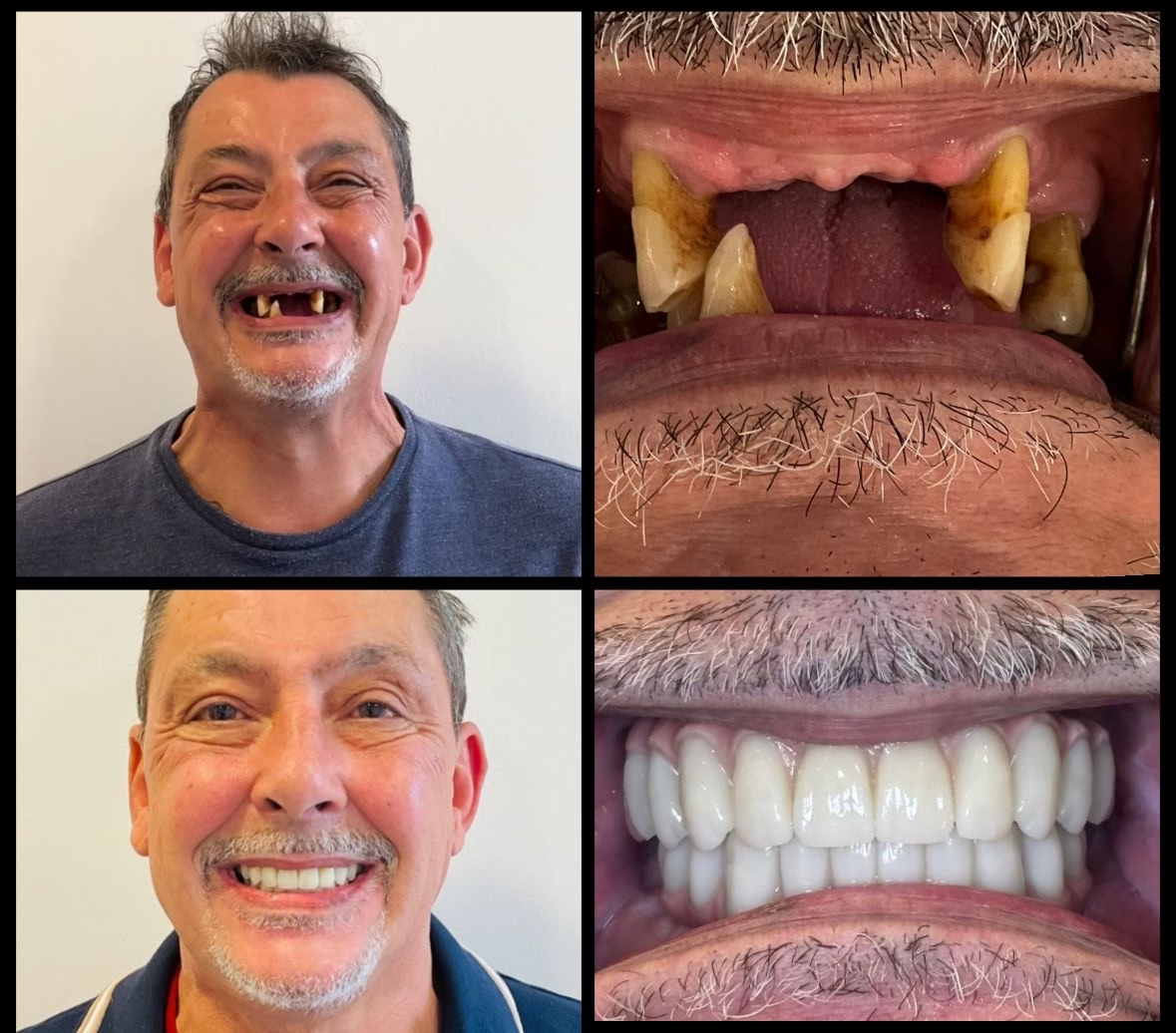
Host 2: Well, at a mechanical level, all on four, which is sometimes marketed as teeth in a day, is a surgical protocol designed to replace a full arch of teeth.
Host 1: And an archive.
Host 2: An arch being all of your upper teeth or all of your lower teeth. Got it. So the four refers to the number of titanium dental implants used to support that entire fixed bridge of teeth.
Host 1: Just four.
Host 2: Usually four, yes. Sometimes, depending on a patient's bone density, a clinician might use up to six implants, but the underlying principle remains the exact same. You are supporting a full row of securely fixed teeth using a minimal number of strategic implants.
Host 1: Okay, I'm gonna stop you right there because intuitively that just does not make sense to me.
Host 2: Fair enough.
Host 1: Traditional dental implants usually require one implant per missing tooth, right? Or at least eight to ten implants to hold up a full arch.
Host 2: Historically, yes, that was the standard.
Host 1: So if the human jaw exerts a massive amount of bite force, like, especially when you're chewing something like a tough steak, how can just four implants not just immediately fail under that pressure? It sounds like putting a heavy tabletop on four flimsy toothpicks.
Host 2: It's a totally valid concern, and it is the exact hurdle that digital dentistry had to overcome. This is where we go back to your cathedral analogy.
Host 1: Oh, the architecture.
Host 2: Yes. The secret isn't in the number of implants, it is in the geometry of how they are placed.
Host 1: Okay, explain that.
Host 2: Well, in traditional implantology, implants are driven straight up and down into the jawbone. But in the all-on-four protocol, the two implants at the back of the mouth, the posterior implants, are placed at a severe angle.
Host 1: How severe?
Host 2: Typically up to 45 degrees.
Host 1: Okay, let me try a different analogy then. If I am trying to mount a really heavy television on my living room wall and the drywall is thin, I can't just hammer a nail straight in.
Host 2: Right, the TV will rip right out of the wall.
Host 1: Exactly. But if I drive a long screw in at an angle to intentionally hunt for that thick wooden stud behind the drywall, it can hold almost anything. Is that basically what we were doing in the jaw?
Host 2: That is an excellent way to visualize it, yes. You see, when people lose their teeth, they don't just lose the visible tooth part, they lose the root.
Host 1: Right.
Host 2: And without the mechanical stimulation of chewing traveling down the root into the jawbone, the body essentially thinks, oh, we don't need this bone anymore, and begins to dissolve it.
Host 1: Wow.
Host 2: Yeah, it is called bone resorption.
Host 1: Which is why people who have worn dentures for decades often find their jawline shrinking. Like the bone is literally melting away.
Host 2: Precisely. The bone volume just decreases. And in the past, if a patient with severe bone resorption wanted implants, they would have to endure complex, frankly, painful bone grafting surgeries.
Host 1: Where they had bone in.
Host 2: Yeah, they would take bone from another part of the body, graft it to the jaw, and wait six to nine months just to see if it took. And that's before even starting the implant process.
Host 1: That sounds exhausting. But the angled implants change that equation entirely.
Host 2: They do. By tilting those back implants at a 45 degree angle, the surgeon can completely bypass the areas of thin resorbed bone. They anchor the implant directly into the denser, thicker bone further forward in the jaw. You are maximising the use of the patient's existing bones. That is clever. And furthermore, that angle actually increases the surface area contact between the titanium and the bone, vastly increasing the mechanical stability.
Host 1: So it's literally an engineering workaround for a biological deficit.
Host 2: Spot on, for many patients who have been told previously they have, quote, insufficient bone for traditional implants, this protocol is designed to offer a pathway that can completely avoid bone grafting.
Host 1: That is a massive shift. Okay, so we have this clever structural workaround. Let's look at who this is actually aimed at, particularly when we contrast it with traditional removable dentures. Looking at Azure Dentals' patient profiles, traditional dentures seem to be a major source of daily misery for a lot of people.
Host 2: Oh, absolutely. Traditional dentures, they rely on suction or, you know, messy adhesives to stay in place.
Host 1: The pastes and glues.
Host 2: Yeah. And for the upper jaw to get that suction, the denture basically has to cover the entire roof of the mouth, which is known as the palate.
Host 1: And covering the palate causes issues with tasting food, right? I've heard that.
Host 2: Massively. We often think taste buds are only on our tongue.
Host 1: Right. That's what we're taught.
Host 2: But a significant number of taste and temperature receptors are actually located on the hard and soft palate.
Host 1: Really?
Host 2: Yeah. So when you cover that with plastic, food becomes incredibly bland. You lose the sensation of a hot cup of tea or a cold glass of water. That sounds awful. It is. But because an All-on-4 bridge is anchored securely into the bone, it does not need to cover the palate at all. It is shaped much more like your natural teeth.
Host 1: Oh, so you regain your sense of taste and you aren't dealing with a chunk of plastic covering the roof of your mouth.
Host 2: Exactly.
Host 1: But what about the bite force? Say someone wants to eat a crusty baguette or, I don't know, bite into a crisp apple.
Host 2: Well, with a traditional loose denture, biting into an apple creates a lever effect. It will simply pop the denture right out of place at the back.
Host 1: Embarrassing.
Host 2: Very. But because the all-on-four bridge is fixed, the bite force is transferred directly into the jawbone, just like natural teeth. Many patients find it allows them to return to a completely normal diet.
Host 1: Okay, so the engineering makes total sense on paper. But executing this sounds incredibly risky to me. How so? Hitting a tiny area of dense bone at exactly 45 degrees while supposedly avoiding nerves and blood vessels in the face. Yeah. I mean you can't just eyeball that.
Host 2: No.
Host 1: How does the clinical team at Azure actually execute this without just guessing?
Host 2: Well, you're right. You cannot eyeball it. And in modern digital dentistry, you don't have to. When we review Azure Dental's clinical pathways, the entire procedure revolves around a piece of technology called a C B C T scanner.
Host 1: Okay. CBCT. What does that stand for?
Host 2: It stands for cone beam computed tomography.
Host 1: And how is that different from, you know, the standard X-ray I normally get at the dentist where I have to bite down on that uncomfortable piece of plastic?
Host 2: Right, those are bite wings. Well, a standard dental X-ray is basically a 2D shadow of a 3D object. It tells you very little about the actual thickness or density of the bone, but a CBCT scanner actually rotates around the patient's head and takes hundreds of images from different angles.
Host 1: Like a medical CT scan.
Host 2: Very similar, yes. It stitches them together to create a high-definition three-dimensional digital model of the patient's skull. Wow. It reveals the exact topography of the jawbone, the precise location of the sinus cavities, and crucially, it maps out the mandibular nerve pathway.
Host 1: So it's literally a complete digital twin of the patient's jaw.
Host 2: Yes, exactly. And using specialised software, the surgical team virtually performs the entire surgery on the computer screen days before the actual appointment. That's amazing. They select the exact size of the implant, they set the angulation down to a fraction of a millimetre, and map the trajectory to ensure it utilises the best bone while staying completely clear of any nerves.
Host 1: That is wild. So they build a perfect digital blueprint. They do? But a blueprint still requires an experienced builder, right? Azure Dental is a dentist-led environment, and they emphasise having a highly experienced team. Who is actually doing the drilling and the placing?
Host 2: Well, looking at their clinical roster, the procedures are handled by highly trained implantologists. You have Dr. Verity Hill, who is an advanced All-on-4 implantologist, handling these full arch cases routinely. Right. And then they also have Dr. Amit Mystery, who specialises in highly complex implantology.
Host 1: Complex implantology, meaning what exactly? What happens if a patient comes in, they get that 3D CBCT scan, and the jawbone is just completely gone?
Host 2: Like severe resorption.
Host 1: Yeah. Like even the angled approach won't work. Is it just game over for them?
Host 2: You know, and that is where advanced techniques come in, and why having someone like Dr. Mystery on the team is highlighted in their literature. For patients with extreme bone loss in the upper jaw, he utilises zygomatic and pterygoid implants.
Host 1: Okay, I'm definitely going to need an explanation for those terms. What is a zygomatic implant?
Host 2: Right. So if the upper jawbone has entirely resorbed, a zygomatic implant actually bypasses the jaw completely.
Host 1: Wait, bypasses the jaw?
Host 2: Yes. It is a much longer implant that anchors upwards directly into the underside of the cheekbone.
Host 1: The cheekbone.
Host 2: Yeah, the zygomatic arch. The cheekbone is incredibly dense and rarely suffers from bone loss.
Host 1: So it's almost like using a specialised grappling hook to reach higher up and find solid rock when the ground beneath you has crumbled away.
Host 2: That is a very vivid but highly accurate way to describe it, actually. Yes. It allows patients who have been turned away by multiple other clinics to still receive a fixed set of teeth.
Host 1: Fascinating. Okay, now let's talk about the patient experience itself. Because the clinic is located opposite Waitrose on school lane in Formby, so it's super easy to get to.
Host 2: Very convenient.
Host 1: But walking through the door for major facial surgery is still daunting. How does Azure handle the psychological barrier for nervous patients?
Host 2: Their protocols are heavily focused on a gentle anxiety-reducing approach. They aim to minimise discomfort using advanced local anaesthetic techniques.
Host 1: Numbing it properly.
Host 2: Right. But for many, even that isn't enough. Just the idea of it is too much. Which is why they offer dental sedation.
Host 1: Like going to sleep.
Host 2: Well, intravenous sedation puts the patient into a state of deep relaxation. You are conscious enough to respond to commands.
Host 1: Like open wider.
Host 2: Exactly. But you are completely detached from the anxiety of the procedure, and most patients have little to no memory of the surgery afterwards.
Host 1: Well, that makes tackling a procedure like this much more accessible. You just sort of skip the scary part mentally.
Host 2: Exactly.
Host 1: So let's talk about the timeline. If a listener from Crosby decides to go for this, what is the actual journey?
Host 2: The step by step.
Host 1: Yeah. Because the phrase teeth in a day gets thrown around a lot. I have to ask, is that literal? Do you walk in with a failing smile and walk out with your final perfect teeth before dinner time?
Host 2: It is a very catchy phrase, but we really need to ground it heavily in clinical biology.
Host 1: So no.
Host 2: Well, it is highly effective, but it is a staged medical procedure. It's not an instant miracle.
Host 1: Walk us through it.
Host 2: Step one is always the consultation and that CBCT scan we talked about.
Host 1: Right.
Host 2: Without that 3D mapping, suitability just cannot be determined. Makes sense. Once the digital plan is finalized, we arrive at step two, which is surgery day. This is the day referenced in teeth in a day. On this day, any failing teeth are extracted and the implants are placed.
Host 1: And do they actually leave with teeth on that day?
Host 2: They do. They leave with a fixed set of teeth that day. However, it is a provisional or temporary bridge.
Host 1: Oh, temporary.
Host 2: Yes. It is usually milled from a high-grade medical polymer called PMMA.
Host 1: So it's a form of advanced acrylic? Basically. Why use that instead of the final material straight away?
Host 2: Well, PMMA is slightly softer than natural teeth. During the healing phase, this material acts almost like a shock absorber.
Host 1: Oh, I see.
Host 2: It looks natural and functions well enough for you to regain chewing confidence immediately, but it dampens the bite forces slightly, which protects the newly placed implants.
Host 1: Because the implants aren't fully secure yet. I want to go deeper on this. What is actually happening biologically during this healing phase? I understand this is step three.
Host 2: Yes, step three. And this is the most crucial part of the whole protocol: osteointegration.
Host 1: Osseointegration.
Host 2: Right. When a titanium implant is placed into the jaw, a fascinating cellular process begins. Titanium has a really unique property. It forms a microscopic oxide layer on its surface that the human body does not recognise as a foreign object.
Host 1: Wait, the body thinks the metal is bone?
Host 2: Essentially, yes. Specialised bone cells called osteoblasts migrate to the surface of the titanium and they begin laying down new living bone matrix directly onto the threads of the implant.
Host 1: That's incredible.
Host 2: It is. Over the course of three to six months, the jaw bone literally fuses with the titanium at a cellular level, locking it into place permanently.
Host 1: Wow. And while that microscopic fusion is happening, the patient's gums are also healing and changing shape, right? Which I assume is another reason you don't fit the final expensive teeth on day one.
Host 2: Exactly. If you built a highly customised permanent bridge on the day of surgery, three months later, when the gum tissue has healed, settled, and shrunk slightly, it wouldn't fit. Right. That bridge would no longer fit flush against the gums. It would create food traps and aesthetic issues.
Host 1: Which brings us to the final step, step four. Once the jaw has fused to the implants and the gums have completely settled, what are the definitive teeth actually made of? I am assuming it's not that shock-absorbing PMMA anymore.
Host 2: No. For the definitive bridge, patients generally choose between an advanced composite material or, for the highest level of durability and aesthetics, a material called zirconia.
Host 1: Zirconia. Like the fake diamonds?
Host 2: Well, it is part of the same mineral family, zirconium dioxide, but it's engineered specifically for medical use. Okay. It is a ceramic with an incredibly dense crystalline structure. What is fascinating about dental zirconia is that it is highly resistant to cracking and it mimics the exact light-reflecting properties of the translucency of natural tooth enamel.
Host 1: So it doesn't look flat or fake?
Host 2: Not at all. It gives a beautifully natural result while being incredibly strong.
Host 1: Alright, I want to pivot here and look at the bigger picture, because we always commit to giving a balanced view on this deep dive.
Host 2: Of course.
Host 1: The engineering is clever, the biology is fascinating, the digital mapping is precise, but nothing in medicine is perfect.
Host 2: No, it isn't.
Host 1: I'm gonna push back here.
Host 2: Huh.
Host 1: What is the catch? This cannot be a set it and forget it situation where a patient gets a zirconia bridge and just never has to think about dental hygiene ever again.
Host 2: I am incredibly glad you brought this up. If there is one thing listeners take away from this whole analysis, it should be this. A successful surgery is only the beginning of a lifelong commitment.
Host 1: Really?
Host 2: Yes. You cannot treat a full art implant bridge like a new set of tires on a car.
Host 1: Because it's still attached to living biology.
Host 2: Right, exactly. While the zirconia and the titanium obviously cannot get cavities, the living gum tissue surrounding those implants is still highly susceptible to bacterial infection.
Host 1: Ah, of course.
Host 2: If plaque is allowed to build up beneath the bridge, it causes inflammation. It's a condition known as periimplantitis.
Host 1: Periimplantitis.
Host 2: Yes. And if left untreated, the bones surrounding the implants will begin to resorb again and the entire structure can fail.
Host 1: So if you don't maintain the foundation, the new house collapses anyway.
Host 2: Precisely.
Host 1: What does the maintenance actually involve, practically speaking?
Host 2: It requires stringent daily home care. Patients must use water flossers, specialised superfloss, or interdental brushes to clean that microscopic gap between the bridge and the gums every single day.
Host 1: It's a non-negotiable routine.
Host 2: Absolutely. Furthermore, regular maintenance appointments at the clinic with the hygienist and the implant team are absolutely essential.
Host 1: Now I noticed in Azure Dentals literature, they offer a minimum five-year guarantee on their All-on-4 treatment, covering the fixtures and the workmanship. But there's a caveat to that, isn't there?
Host 2: A very strict caveat, yes. The guarantee is entirely conditional upon the patient attending their scheduled maintenance appointments and demonstrating diligent home aftercare.
Host 1: So if you don't do your part, the guarantee is void.
Host 2: Basically, if you don't do your part, the clinic cannot guarantee the biological longevity of the implants. It is very much a partnership.
Host 1: But true partnership, yeah. Okay, let's talk about the financial reality of this partnership. We are not going to list off specific prices today because as we have established, every mouth is completely different, and costs vary based on whether someone needs those zygomatic implants extractions or if they choose composite versus zirconia.
Host 2: Right. There are too many variables.
Host 1: But we need to frame the investment.
Host 2: Broadly speaking, because the All-on-4 protocol utilises fewer implants and aims to avoid complex separate bone grafting surgeries, it is generally considered a more cost-effective and time-efficient pathway compared to the older method of placing eight to ten individual implants.
Host 1: However, it is still advanced facial surgery utilising highly engineered materials, is going to be a significant financial investment in one's health.
Host 2: It definitely is. And recognising that, Azure Dental has integrated flexible finance options to make it more accessible for people.
Host 1: What kind of options?
Host 2: They offer up to 60 months of finance, subject to status, as well as short-term 0% interest-free plans.
Host 1: And people don't have to just guess what this might cost them before coming in, do they?
Host 2: No, and this is a really great feature, actually. On the Azure Dental website, they host a dental implant estimate calculator alongside a finance calculator.
Host 1: Oh, that's handy.
Host 2: Yeah, you can anonymously plug in your specific scenario and receive a personalized estimate and a monthly breakdown. It allows patients to privately explore the financial landscape from their own living room before ever even booking a consultation.
Host 1: I really appreciate that approach. It removes that fear of the unknown.
Host 2: Completely.
Host 1: All right, let's summarize what we've unpacked today. The All-on-4 treatment is an advanced surgical protocol designed to help patients struggling with failing teeth or loose dentures. Yep. By utilising CBCT 3D digital planning and precisely angling four to six implants, the clinical team aims to maximise existing bone, often avoiding bone grafts entirely.
Host 2: Exactly.
Host 1: And patients leave the surgery with a fixed provisional bridge, allowing the jawbone to naturally fuse with the titanium before a highly durable, custom designed final bridge is fitted.
Host 2: It is a comprehensive pathway, really, to restoring chewing function, facial structure, and frankly, confidence.
Host 1: Yeah.
Host 2: But um, as we close today, I want to leave you with a slightly different concept to think about.
Host 1: Okay, what's that?
Host 2: We've talked extensively about the digital blueprints and the mechanics of bite force. But consider the amount of subconscious mental energy spent every single day worrying about a slipping denture or hiding a failing smile.
Host 1: Oh wow. Yeah, just the constant background stress of it.
Host 2: Exactly. Reclaiming that mental space can often be just as impactful as the physical restoration of the teeth themselves.
Host 1: Reclaiming your mental space. That is a phenomenal thought to end on. It truly is about more than just the mechanics.
Host 2: Yeah, absolutely.
Host 1: Well, if this deep dive has sparked your curiosity and you are located in Formby, Liverpool, Southport, Crosby, or the surrounding areas, we want to pass along a low-key invitation. If you are wondering whether this gentle, digitally planned approach might be suitable for your own clinical situation, we invite you to book a consultation at Agure Dental. They are conveniently located opposite Waitros on School Lane.
Host 2: It is purely an opportunity to get professional guidance on your unique anatomy.
Host 1: With absolutely no hard sell or pressure.
Host 2: Just a thorough conversation about what modern dentistry might be able to achieve for you.
Host 1: Exactly. Thank you so much for joining us as we explore this intersection of engineering and human health. Keep asking questions, keep exploring, and we will see you on the next deep dive. Take care, everyone.